




Luxor
The world’s greatest open-air museum on the banks of the Nile.
The Ancient Capital of Thebes
Once the glorious capital of ancient Egypt, Luxor is often called the world’s greatest open-air museum.
Home to legendary temples, royal tombs, and timeless Nile scenery, Luxor is a must-visit destination for travelers seeking history, culture, and unforgettable heritage.
Often compared to the Pyramids of Giza in importance, Luxor feels like a living museum. The city is divided by the Nile into two symbolic sides:
- East Bank — The Land of the Living
Modern Luxor city, temples, and vibrant life.
- East Bank — The Land of the Living
Necropolis, royal tombs, and mortuary temples.
In ancient Egyptian belief, the setting sun symbolized the journey to the afterlife — making the west bank the perfect resting place for pharaohs and queens.
- Location
- Upper Egypt
- Currency
- Egyptian Pound (EGP)
- Style
- Culture • History
- Language
- Arabic
✦ Why visit Luxor
- The Heart of Ancient Egypt
- A City Divided by Myth
- Perfect for Culture Lovers
Popular Tourist Place
Temple of Luxor
Temple of Karnak
Valley of the Kings
Valley of the Queens
Medinet Habu
Luxor Museum
Colossi of Memnon
Why Choose Elaria

Local Expertise
Our Egypt specialists design deeply immersive historical journeys.

Personalized Itineraries
Every Luxor trip is tailored to your travel style.
24/7 Support
From planning to your return home.
Best Time To Visit
Winter (December – February) — Peak Season
- Weather: 18–26°C
- Why visit: The most comfortable time for Nile cruises, and hot air balloon rides
- Perfect for: Luxury travelers, families, first-time visitors
Spring (March – April) — Great Weather & Fewer Crowds
- Weather: 22–32°C
- Why visit: Warm but still pleasant, ideal for outdoor tours with fewer tourists than winter.
- Perfect for: Couples, photographers, relaxed cultural trips
Autumn (October – November) — Shoulder Season Favorite
- Weather:25–33°C
- Why visit: Excellent balance of warm temperatures and manageable crowds. A wonderful time for Nile views and sunset visits.
- Perfect for: Culture lovers and adventure travelers
Summer (May – September)
— Low Season
- Weather:35–45°C
- Why visit: Very hot but the most affordable time to travel. Tours run early morning and late afternoon to avoid the heat.
- Perfect for: Budget travelers and early-morning explorers
- Best overall time to visit: October → April 🌤️
Discover Luxor
Built by Amenophis III and expanded by Ramses II, Luxor Temple is connected to Karnak by the legendary Avenue of Sphinxes (Dromos).
- The temple was dedicated to the Theban Triad:
Down the road is the oldest mosque in Luxor. It contains the remains of a 10th century Islamic saint who was a monk prior to converting to Islam. The mosque is a popular pilgrimage destination. Here also is the Franciscan Church and its schools, one for boys and the other girls. Beyond this lies a great Coptic basilica. And than you will find the Luxor Museum. All the relics are from the surrounding area and instead of that the museum is not very big it gives nice demonstration of the sense of the Luxor.
- Amun — King of the Gods
- Mut — The Mother Goddess
- Khonsu — God of the Moon

The Largest Religious Complex Ever Built
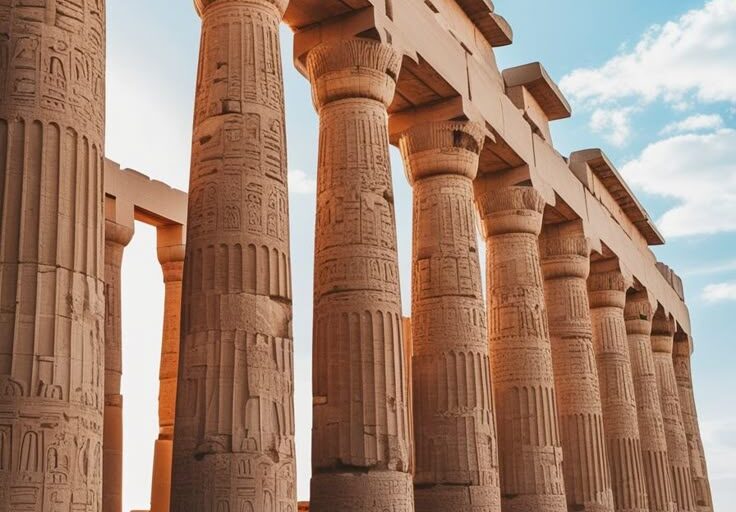
Karnak is not just a temple — it is a vast sacred city built over more than 2,000 years by generations of pharaohs. The scale is astonishing: entire European cathedrals could fit within its walls.
The highlight is the Great Hypostyle Hall, a forest of 134 towering columns covering 54,000 square feet — still the largest room in any religious building worldwide.
Why visit
- Monumental scale and history
- The famous Hypostyle Hall columns
- One of the most important religious sites in history

A Curated Journey Through Ancient Thebes
Located along the Nile Corniche, Luxor Museum offers a refined and beautifully presented collection of artifacts discovered in the surrounding temples and tombs.
Unlike larger museums, its elegant displays make it easy to understand the story of Luxor and ancient Thebes in a calm, immersive setting.
Why visit
- Carefully curated archaeological treasures
- Perfect introduction to Luxor’s history
- Quiet, elegant museum experience

After this, you will take a boat trip to the West bank. This trip had a special meaning as you are crossing the way to the West and life to a necropolis. The Valley of the Kings with tombs from the 18th and 19th Dynasties. In this valley was found over 60 tombs, most of them had been robbed and this fact led to move the royal mummies to the secret tomb outside.The tomb was discovered in 1881 and the most famous in this valley is the tomb of King Tut. Outside the Valley of the Kings, the road leads past Antef, named for the 11th Dynasty princes who were buried here. Some of tombs can still be seen as one heads towards the Temple of Seti I. Most of what is left of Seti’s Temple is the view. The court is entered by the ruined gate of a pylon. The road continues south passing Dra-Abu el-Naga necropolis.


It is another of Thebes’s major attractions. The gate has square towers and appears almost oriental. Behind the complex is the workmen’s village called Deir el-Medina. Out in the fields near here is the famous Colossi of Memnon, one of the major tourist attractions throughout time. Southwest of Deir el-Medina is the Valley of the Queens, where queens of the 18th and 19th Dynasties were buried. From here, the road continues past the mudbrick remains of Amenhotep III’s palace called Malkatta. There is a lake to the east and at the other end of that, a small Roman temple called Deir Shelwit built at the end of the 1st century.


FAQ
Is Luxor worth visiting?
- Absolutely — Luxor is considered one of the most important historical destinations in the world.
How many days do you need in Luxor?
2–3 days is ideal to explore both East and West Bank comfortably.
Can Luxor be visited from Hurghada or Cairo?
Yes — Luxor is one of the most popular day or overnight trips.